Tuesday, August 20, 2013

ACW Game - Longstreet 'Lite'

Those with long memories (or too much time on their hands - I'm not here to judge!) may recall that a few months ago I completed a pair of ACW armies and promised to soon post pics of the based results.  Well, what has happened with it all?  For one thing, after the frantic speed of painting them all I was so overdosed on ACW Union infantry I just wanted a complete break from them all.  After that however, there came the realisation from me that I could be about to completely change the basing system.  

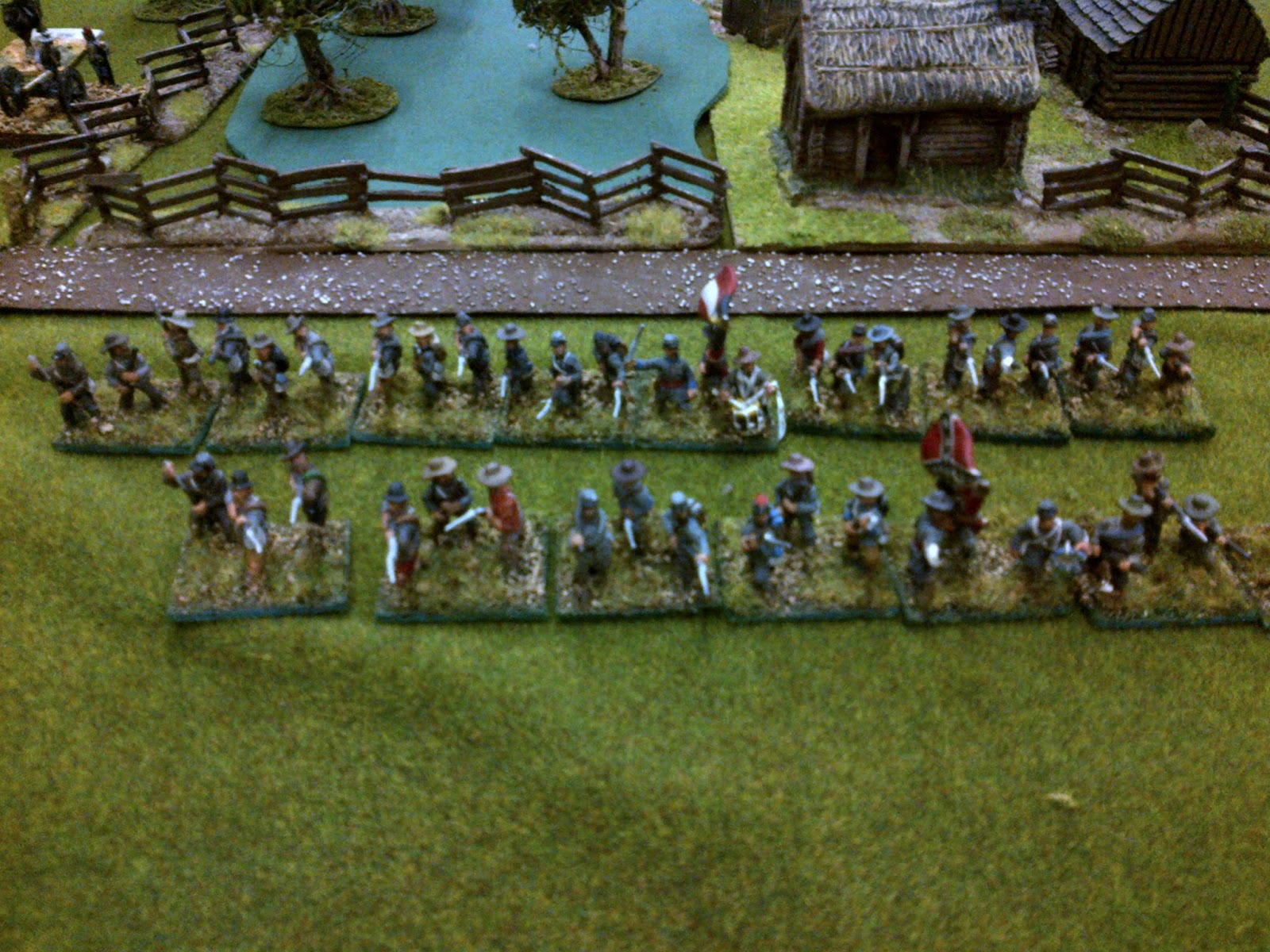
This last point came from me joining the Falkirk District Wargames Club (FDWC) over the last few weeks, and learning about the upcoming 'Longstreet' rules for ACW that were coming out.  They favour multi-based units with roughly 6-8 bases as the typical norm, and in the 60x30mm bases of 4 figures each, it all looked like a skirmishing line to me - I was not happy!  

At club however, a trial game was held to see how the 'Lite' version of the rules played (ironically we wound up trying them out on Monday, the very day the full set came out!)  I joined in to play a game with another members' 15mm collection, hoping to get a bit of inspiration.  Some pics of the game are below.


The battlefield at the start.  Nice fences, made of matchsticks!

Rebel infantry in its natural form - streaming ahead towards a Union line!

The basing system here uses 3 figures a base, in a slightly offset line.  It can look a bit odd on a solitary base, but actually looks quite good by the unit. 

Two regiments together.  I think I'll go for the same with my 1/72 figures, possibly on a 30mm or 40mm square base.

I played the Union, and although my brigade nearly broke it managed to steal a win at the very last turn by the use of the 'Withering Fire' card, cutting down scores of Rebels in a hail of fire and a series of lucky rolls, which saw their morale break just ahead of mine.

And yes, I have the full set of rules now on order...

Sunday, July 14, 2013

Maurice - Austrians v Prussians


After a few weeks of going along to the club and joining in with other peoples' games, I felt I should bring along something of my own to contribute.  The perfect chance came along with a decision to play a game of 'Maurice' for the Seven Years' War.  The 'Maurice' rules are by Sam Mustafa, and one of his earlier rulesets was 'Might and Reason' - which used to be my old favourite!  We gave it a go one week to try out, and the following week I offered to bring along my 15mm Prussian & Austrian figures for a replay.

The results are in the photo above!  Unfortunately I was only able to take one or two pics on my mobile, as you tend to get caught up in the game with other folk there at the club.  I went the Prussians, attacking an Austrian line spread out across a low hilly region.  I had intended to flank the line with some fancy marching, but sadly it was not to be - the Austrians played a surprise card (appropriately called "That's not on the map!") which let them place an unexpected piece of terrain - the large marsh you can see on the left of the above photo!  My plan derailed by this, I switched quickly to screening both flanks and simply blasting through his centre - the clash of the two infantry lines can be seen above.

Thanks to some 'national characteristic' cards I could count on the Prussian infantry having an advantage over their foes in a one-on-one fight, but somehow the cards never quite panned out that way.  Numerous 'upset' cards that reduced fire effectiveness or prevented firing just seemed to keep on turning up.  Also, many units that were wavering pulled off some spectacular rallies to keep the fight going.  In Maurice you play cards to keep units active, and the fighting in the centre was so intensive that both sides were forced to keep on playing cards turn after turn to prevent a collapse, as opposed to bringing in other units on the flanks into play.

The end result was a scrappy draw, with a possible nominal win going to the Prussians - or whatever was left of them - as their advantages finally tipped the battle for the centre their way.  Not a particularly elegant one, however - just a heads-down victory by battering away headlong at the enemy, and winning through the infantry training as opposed to leadership!  ;-)

Two after-effects of the game are that there is now talk of possibly doing a campaign of games, using the Maurice system for linking them together.  Not sure if there's enough people for it, plus of course we haven't necessarily all got collections in the same scale, but the notion is appealing.  The second is the realisation for me, which would have slipped past me without somebody mentioning it, that a new Maurice-style game for the ACW is about to come out from Sam Mustafa!  Having just finished up painting my two armies for ACW, and being quite taken with the Maurice-like card system, I'm actually eager to get the rules and see about getting my figures organised for using with the upcoming new rules.

Sunday, June 23, 2013

Going 'Clubbing'

I recently started something that I haven't done before - or at least not for many, many years: I went to a wargames club to get a bit more sociable with my hobby!  Turns out, it was a marvellous idea and now I regret that I didn't think to do it any earlier.

After Carronade was put on by the Falkirk District Wargames Club (FDWC) I reasoned that as they seemed active, and were one of the nearest to me, I should head along for a look.  I've been along three times now, and each time has seen me doing something different to anything else I've done before.

1st night - Muskets and Tomahawks
I was invited into a game which was a skirmish in the American colonies, between the British (of which I was given some of the green-coated Rangers) and the Americans.  The latter were herding a group of cattle across the table, while we attempted to stop them.  I had quite a fun time of it, taking pot-shots at the rebels from nearby woodland - at least until they descended mob-handed to drive me off!  Still, it took them far more manpower than I used, so I figured it for a moral victory!

2nd Night - Air Combat!
I've never played any air-wargame before, but somebody asked me to fly into a game called 'Check your Six!' which was set in the jet-age, during an Indo-Pakistan conflict.  My pilot and wingman were sadly a completely useless duo, mainly due to my inability to properly maneuver a jet-plane.  Too slow, too fast, turning the wrong way - there's a lot to master!  Basically I wound up trying to turn in ever-widening circles, while everybody else fought it out.  By pure chance, or possibly because the lack of threat I presented was obvious, I was the only player who never lost a plane.  I also never shot anything down either, I suppose, but I figure that averages out to a decent showing!

3rd Night - Naval Combat!
I joined in with a game of Too Fat Lardies' 'Kiss Me Hardy' rules, covering Napoleonic naval combat from the age of sail.  I led one of two French squadrons out on the ocean, fighting off an intercepting pair of Royal Navy squadrons.  Sadly for us all, nobody was too practiced at the rules and we failed to anticipate that having your ships too close together nose-to-tail might not be a good idea: especially not if somebody rammed somebody else, and the whole line suddenly stopped, triggering an embarrassing pile-up in the middle of an empty sea!  Many ships were shot to ribbons, boarded, set afire, and generally had their re-sale value reduced.  Although the British won a good tactical victory, we did at least manage to slip by with most of our ships intact and blasted their rigging enough to mean pursuit wasn't possible - giving us a strategic victory.  

Overall, the last few trips have been a wonderfully positive thing - I've met a load of new folk in the hobby, found them to be friendly and welcoming, and have been introduced to all sorts of new rules and historical periods I would have never considered myself!  More of the same to come, hopefully.

Thursday, May 30, 2013

Bases & Stuff...

Just a quick update, on something which I've meant to get for some time to help with the Wars of the Roses figures.  I have bought myself a stack of movement trays, like the ones shown below:  


I had some MDF bases already to act as movement-trays but they were never really satisfactory as, of course, all the individually-based models just slid around unless you lifted them and kept it precisely level at all times.  

The new ones in the above photo have got regularly spaces indents designed to let you slot a 1p-coin or a similarly-sized washer into them, so your figures stay in place and don't shuffle around!  

I bought them from warbases and thought I would recommend them, given how well they've done the job.  

Tuesday, May 21, 2013

Recruiting Retinues - Again!

As mentioned by my previous posts, I'm heading in my 'Wars of the Roses' re-fight towards my own little 'Towton' climactic battle of mass-destruction.  I want to do it justice, and I think the one thing that has become instantly and undeniably obvious is that I need the maximum number of figures I can get!  After totting up lists and accounting for odd types like mercenaries, cavalry, skirmishers etc. I have ultimately come up short from my existing supplies.  This has led me to only one conclusion: I need to bite the bullet and buy more.

After the long months and years of painting the mammoth pile of my last WOTR figures, I came away swearing that I would never again buy more and put myself through all that again.  Well, that's gone up in smoke now, as I was at Carronade 2013 the other week and have bought the two extra boxes of Perry Miniatures I think I need.  I believe I now have a grand-total of something like 475 figures for WOTR - alarming!  

For the battle coming up I will field one 'Bloody Barons' unit (eight figures, taking each figure as a 'base') per 1cv of strength-points in the campaign game 'Richard III', so this means I should actually only need about 350-odd figures.  The need for more is still there because of the varying livery colours I've got (Warwick, for example, isn't present so all his lads will sit this one out in a box!)  I think it's one of the drawbacks of starting out in the Medieval period, in that once figs are painted you are kind of landed with the consequences of whatever livery combination you picked.  Thankfully I'm now building up a collection to the stage where I can basically stage a major battle like this one, fill my available table pretty much to capacity with correctly-painted miniatures, and still have some unused spares.  

For what it's worth, my 'work in progress' list looks something like this:

Edward of York
1 Household & 2 Retinue units (Blue & Murrey liveries)
Duke of Clarence
3 Retinue units (Blue & Murrey)
Lord Herbert
3 Retinue units (Blue & Red)
Earl of Rutland
1 Retinue unit (Blue & Murrey)
Henry VI
1 Mounted Unit ('white armour' - no liveries)
1 Household & 2 Retinue units (Blue & White liveries)
Duke of Somerset
3 Retinue units (Blue & White)
Earl of Salisbury
2 Retinue units (Red & Yellow)
Duke of Norfolk
1 Retinue unit (Blue & Yellow)
Edward of Lancaster
1 Household & 2 Retinue units (Red & Black)
Duke of Buckingham
3 Retinue units (Red & Black)
French Mercenaries
2 Mounted units (None), 1 Crossbow unit (French), 1 Retinue unit (Blue & White or None)
Newcastle Levies
2 Levy units, all Longbowmen (None)
Scottish Mercenaries
2 Levy units, all Spearmen (None)
Burgundian Mercenaries
1 Handgunner unit, 2 Pike units (Burgundian)
Irish Levies
2 Unarmoured units, Kerns (None)
2 Levy units, all Spearmen (None)
Norfolk Levy
3 Levy units, all Longbowmen (None)

A 'typical' unit is one captain/Man-at-Arms, three Billmen, and four Longbowmen.
A mounted unit is six models. (Or possibly eight - I haven't decided yet.) 

Wednesday, May 15, 2013

ACW Painting


I have finished my Union army!  Also, in an even more incredible achievement, I did it in record time!  

The slightly smaller Confederate army was bought in February 2012 and completed in December 2012, meaning it covered a grand total of 10 months.  The larger Union army was  bought in February 2013, and have finished it in May 2013 - barely three months!  Have I undergone a three-fold increase in painting speed?  Sadly no, but the experiment has provoked a few thoughts on painting, and here are some of my 'insights', as I might grandly call them:

  • The Type of Figure matters!  The rag-tag nature of the Confederates meant I spent a lot of time hemming and hawwing about them - 'does this brown coat go with those grey trousers?  Do those blue trousers go with a black hat?  Is this figure too close a copy of that one?'  All these variations created a bit of a pain, which didn't happen with the union: blue, blue, and more blue!  Bang - job done!  Admittedly some armies like medieval ones or irregular forces will always have a variety, but a generally 'uniform' force in the literal sense will have advantages - worth considering at the planning stage, anyway.  
  • Real Life Matters (but not as much as you might think!)  While painting the Confederates, I put my flat on the market, sold it, and moved into a new house - it's fair to say that a lot was going on!  However, I don't think that I can really hide behind all that.  It had an effect, but overall I think if I'm honest I still had a lot of free time in evenings and so on, but I was put off by the idea I would 'only' get an hour or so to do anything, so I did nothing.  I think that even a minor bit of grit and determination would have greatly slashed my painting time.
  • Go for Mass!  In my Confederate painting I did a base here, then one there, etc.  It seemed to go nowhere, even as I progressed!  With the Union army, I forced myself to do the whole lot as a big, indigestible lump.  Everybody got their shoes painted, and until everybody had that done nobody - but nobody! - got anything else, like their belts, even so much as started.  Tedious?  Oh god, yes - but I resisted the temptation to split the force up into smaller batches, as I was certain that once I'd done one batch I'd never be able to face a second. The tenacity paid off, as although painting belts or shoes and nothing else was dull, I managed to finish each 'part' before the boredom got too much, and then I was spurred on by the knowledge that I would never have to do it again.
  • Focus!  Basically, don't get distracted with other things.  While the Union army was getting painted, I had my Wars of the Roses campaign, my remaining Anglo-Allied Waterloo army, a potential new WW2 Bolt Action army, and two new Ancients armies swirling around as either 'in progress', 'bought' or 'under consideration.'  However, I stuck with the Union 100% through my painting without any deviation - because I knew if I stopped, I'd not restart fr a long time.
  • In a word: Momentum!  If I was to sum all of the above up in one entry, this would be the central idea.  Momentum, or the sensation that a project is 'underway' and making progress rather than 'on standby' and gathering dust, is critical.  It's also a self-fulfilling prophecy in a way, for it did indeed conform to how I planned things, with even a little investment in willpower.  Now I have the rewards of it all, as I can knock off the Union ACW project off my to do list, and get more done with other things.  A real example of how a bit of self-discipline isn't just good as an abstract concept, but genuinely and immediately bears fruit! 

Photos to follow shortly.  (Right - now to base them up and get to the games table!)

Sunday, May 12, 2013

Order of Battle, 1461

[Transcription from scrolls found in the alternate-history records:]

Roll of those magnates and nobles of declared loyalty to the house of Lancaster, and the anointed king:

The army VAWARD, under the leadership of PRINCE of WALES, EDWARD of Lancaster, heir to the throne of England, and a boy of some seven years of age.  Assisting him in overseeing all practical aspects of warfare is Humphrey Stafford, Duke of BUCKINGHAM.  Also present to advise is Sir Andrew Trollope, lately master of the king's garrison at Calais.  In combination, these nobles bring some 6,000 men to the field.

The MAIN, under the leadership of his Majesty KING HENRY, sixth of his name, crowned king of England and France, Lord of Ireland.  Somewhat reticent in matters military, he is assisted by his advisor Sir Edmund Beaufort, Duke of SOMERSET and erstwhile rival of the pretender's late father, Richard Plantagenet.  Ably assisted by many mercenaries and volunteer troops supplied from FRANCE, the King commands some 8,000 men.

The REARWARD of the host, led by Sir Henry Beaufort, son of Edmund and heir to the Dukedom of SOMERSET, whose warlike disposition sees him lead the family's retainers in the field.  In addition there are many levies from the loyal city of NEWCASTLE under the leadership of Baron POYNINGS and also many mercenary soldiers for hire lately of SCOTLAND, under many worthy captains.  The Rearward force of 7,000 men raises the strength of the ROYAL ARMY to 21,000 loyal men.

Those Magnates and Nobles who profess loyalty to the house of York, claimants to the throne of England:

The VAWARD of those followers of George Plantagenet, Duke of CLARENCE and younger brother to the pretender and youth of twelve years, guided by Sir Walter DEVEREUX.  Richard Neville, 5th Earl of SALISBURY, and noted Welsh Lord William HERBERT - who, between them field 8,000 men for battle.

The MAIN is under the bellicose Edward Plantagenet, 4th Duke of YORK and PRETENDER to the crown, either traitor or rightful heir, as persuasion guides.  Ably assisted by many men of loyalty to his house from IRELAND under Sir Roger VAUGHAN and other mercenaries dispatched from BURGUNDY under captains of war, of good reputation.  This host numbers some 10,000 souls.

The REARWARD is under the direction of the pretenders' other brother Edmund Plantagenet, Earl of RUTLAND.  He is accompanied by John DeMowbray, 3rd Duke of NORFOLK and many diverse levies from NORWICH under the Baron HOWARD.  Much depleted by campaigns in the north, the Rear numbers only 5,000.  The full Yorkist host of the Pretender numbers some 23,000 soldiers and captains.