Following on from last week, I was pondering my notion for a campaign in a more 'narrative' style. As I wrote, I had considered putting together an ACW campaign to use my 1/72 figures in a more 'old-school' style of game. Problem is that the notion is just as applicable to the other campaign I am progressing, the Wars of the Roses.
I spent about a week pondering the two options, weighing up the pros and cons of each. The end result: both options have lots of 'pros' and very few 'cons'. Nice, but not helpful about making a decision anytime before the sun burns out.
Things came to a head when I was browsing on eBay. I know that for wargamers, the phrase "I was browsing on eBay" ranks alongside "I set off alone to explore the haunted house": a danger signal that no good is on the way! I found a sale, for a mountain of plastic 1/72 ACW figures. I put in a bid, sensing it could well be a bargain. The rest of the week was spent in a state of constant mood-swings.
What was I buying them for? What would I do with them? I already had hundreds - what would hundreds more do? I couldn't even fit them all on a table! But imagine having them. They'd be great! I'd never need to buy any more ever again! I could do Charles Grant-style massive units - think of the visual effect!
Of course, the other question was "What about all my Wars of the Roses plans?" I really wanted to do that too, but which one would get the first go? Fate would have to decide.
In the end, by the time the eBay sale ran out I had reached such a state of indecision that I had hidden my mobile phone from myself, so last-minute emails wouldn't tempt me into upping my offer! I was outbid right in the closing minutes, and then experienced the usual mix of relief & regret that accompanies every eBay bid I ever make. So, the ACW plans have instantly receded into the background. Wars of the Roses have taken pole-position, and I have sent off for some new figures for them instead. What a way to run a (miniature model) war... :-)
Showing posts with label plastic figures. Show all posts
Showing posts with label plastic figures. Show all posts
Monday, April 28, 2014

Wednesday, April 17, 2013
Army of the Potomac, taking shape
Busy, busy, busy! I have been forging ahead with the large Union Army of 1/72 plastics, and thought I'd post some photos to show progress (apologies they're a little blurry, but I tried using my mobile camera, and it's not the best.)
 The above snap shows the whole horde at present - roughly somewhat over 200 soldiers. I bought almost all of the figures from Italeri boxes, as I find these to be the best quality and also the easier to track down online. I think I found one solitary box of Imex models on ebay, but that was the only difference.
The mass above have been washed to clear off any moulding residue; clipped off the sprues; glued to card strips (from cut up cereal boxes, no less); spray-painted white with plastikote to prep them for painting, then sprayed back to Blue again (with Army Painter spray of Ultramarine.) Since then I have been painting on an industrial scale, painting all the trousers light blue, then all the shoes black, and now I'm about halfway through painting all the kepi visors/brims black as well.

There is only one, solitary figure that's complete at the moment. This came about from me painting a lot of blue and black, and I creeped myself out that the figures would turn out awfully dark-looking en masse. I finished one off experimentally, and I've reassured myself. The remaining paint-work is almost all light-coloured (pink for the face & hands, light brown for the musket, and some silver/brass where needed, plus a light green base) so the overall model effect seems quite good. I'm not splitting the whole collection up into batches, as I find I always slow down progress when one batch is done and I can't face starting another. As a result, the painting at present is going 'monolithically' - so to speak. The other day it was shoes, and nothing but. Next weekend will hopefully be belts, and nothing else. I'm keeping the focus on single elements so I can quickly bash through the lot, without stopping and re-doing bits here and there.
In a departure from my normal method, I've also glues the figures onto strips together by pose - so there's no fiddling about to make sure I've got all the bits on varying models - if I pick up a card strip all the models are facing the same way, in the same position, so painting all the sides of a shoe or sword, for example, is very simple to do.


The mass above have been washed to clear off any moulding residue; clipped off the sprues; glued to card strips (from cut up cereal boxes, no less); spray-painted white with plastikote to prep them for painting, then sprayed back to Blue again (with Army Painter spray of Ultramarine.) Since then I have been painting on an industrial scale, painting all the trousers light blue, then all the shoes black, and now I'm about halfway through painting all the kepi visors/brims black as well.

There is only one, solitary figure that's complete at the moment. This came about from me painting a lot of blue and black, and I creeped myself out that the figures would turn out awfully dark-looking en masse. I finished one off experimentally, and I've reassured myself. The remaining paint-work is almost all light-coloured (pink for the face & hands, light brown for the musket, and some silver/brass where needed, plus a light green base) so the overall model effect seems quite good. I'm not splitting the whole collection up into batches, as I find I always slow down progress when one batch is done and I can't face starting another. As a result, the painting at present is going 'monolithically' - so to speak. The other day it was shoes, and nothing but. Next weekend will hopefully be belts, and nothing else. I'm keeping the focus on single elements so I can quickly bash through the lot, without stopping and re-doing bits here and there.
In a departure from my normal method, I've also glues the figures onto strips together by pose - so there's no fiddling about to make sure I've got all the bits on varying models - if I pick up a card strip all the models are facing the same way, in the same position, so painting all the sides of a shoe or sword, for example, is very simple to do.

There's also a fair bit of that appealing "detritus" of a model army in the process of assembling. In this case, I have my Newline Designs officers to go (mounted on 2p coins) and also seven artillery pieces, plus a large caisson (from one of the Italeri Union Artillery boxes) which I have vague aims of using to decorate a little 'campsite' diorama for a supply-point.
Sunday, March 17, 2013
What I've been up to...
I can't believe it's been over a month since I last posted - it's certainly not for a lack of activity, anyway! I should really provide some sort of summary of what hobby-linked stuff I've been up to. Over the past few weeks, I have:
Done pretty much no painting!
Okay, not a great one I'll grant you, but following my massive painting bender over Christmas I'm pretty relaxed about taking a little pause. I've focused instead on playing some games, which has been much more enjoyable.
Played a massive board game of WW2!
I have long been a fan of block board-games, and to my mind GMT Games' "Europe Engulfed" is one of the top ones - certainly the best World War Two strategic level game I've played (as opposed to the massive economic simulator that Advanced Third Reich seemed to think it was.) Over a few weekends I've been playing away at it, and - as I went along - wrote out a narrative of the game for myself. I'll tidy it down, edit it up and post it on the blog. I always find these alternative history AAR's to be fascinating reading when other people do it, so I'm finally having a go myself.
Dug out my Hundred Years' War 6mm!
BBC 4 recently had on a little three-part series which was called 'Chivalry and Betrayal: The Hundred Years' War' - and I actually found it to be very good. Also, you fundamentally don't see that many telly shows about wars of the middle ages, so thumbs-up for the Beeb simply for making it! I was also moved to get my old half-rebased, half-unpainted models from Baccus 6mm out of the loft, for a spruce-up and a possible quick mess-around in some DBA-style games.
Ordered my 1/72 Army of the Potomac!
Yes, the completed 1/72 Confederates now have an enemy to face! Or, at least they shortly will. After much obsessive planning and preparing, I have swooped across various Amazon and Ebay marketplaces to gather all my odds and ends. Due to the long gestation of the planning, I have also been able to basically get all the extras I wanted - such as the MDF bases for them all, some lead 'character' figures for generals, and also spray-paints to allow speedy mass-painting of all those blue coats.
Done pretty much no painting!
Okay, not a great one I'll grant you, but following my massive painting bender over Christmas I'm pretty relaxed about taking a little pause. I've focused instead on playing some games, which has been much more enjoyable.
Played a massive board game of WW2!
I have long been a fan of block board-games, and to my mind GMT Games' "Europe Engulfed" is one of the top ones - certainly the best World War Two strategic level game I've played (as opposed to the massive economic simulator that Advanced Third Reich seemed to think it was.) Over a few weekends I've been playing away at it, and - as I went along - wrote out a narrative of the game for myself. I'll tidy it down, edit it up and post it on the blog. I always find these alternative history AAR's to be fascinating reading when other people do it, so I'm finally having a go myself.
Dug out my Hundred Years' War 6mm!
BBC 4 recently had on a little three-part series which was called 'Chivalry and Betrayal: The Hundred Years' War' - and I actually found it to be very good. Also, you fundamentally don't see that many telly shows about wars of the middle ages, so thumbs-up for the Beeb simply for making it! I was also moved to get my old half-rebased, half-unpainted models from Baccus 6mm out of the loft, for a spruce-up and a possible quick mess-around in some DBA-style games.
Ordered my 1/72 Army of the Potomac!
Yes, the completed 1/72 Confederates now have an enemy to face! Or, at least they shortly will. After much obsessive planning and preparing, I have swooped across various Amazon and Ebay marketplaces to gather all my odds and ends. Due to the long gestation of the planning, I have also been able to basically get all the extras I wanted - such as the MDF bases for them all, some lead 'character' figures for generals, and also spray-paints to allow speedy mass-painting of all those blue coats.
Tuesday, January 1, 2013
The Army of Northern Virginia, 1863
Happy New Year! Good luck to you all for the upcoming 2013, and hopefully your 2012 was a good one.
I have a quick little update to post as I have achieved the unheard-of achievement of completing one of my projects in the same year it was started! Back in February 2012 I decided to use 1/72 plastics to play the American Civil War, and bought a bunch to create a Rebel army. I progressed them steadily all through the year, on and off, then just before New Year I managed to finish the last of them.
For interest, I put together the force on a rough one-base-per-brigade line, using the Gettysburg OoB as a guide - although pretty much any battle from 1863-5 should be do-able with some minor tweaking. Here, at least, is the original list:
R. E. Lee Army HQ
Longstreet Corps HQ
McLaws 4 Infantry Brigades
Hood 4 Infantry Brigades
Pickett 3 Infantry Brigades
Corps Arty 2 Artillery Batteries
Ewell Corps HQ
Early 4 Infantry Brigades
Johnson 4 Infantry Brigades
Rodes 5 Infantry Brigades
Corps Arty 2 Artillery Batteries
A.P. Hill Corps HQ
Anderson 5 Infantry Brigades
Heth 4 Infantry Brigades
Pender 4 Infantry Brigades
Corps Arty 2 Artillery Batteries
J.E.B. Stuart Corps HQ (Cavalry)
Lee 2 Cavalry Brigades
Hampton 2 Cavalry Brigades
(total 37 Inf, 4 Cav, 6 Arty)
I have a quick little update to post as I have achieved the unheard-of achievement of completing one of my projects in the same year it was started! Back in February 2012 I decided to use 1/72 plastics to play the American Civil War, and bought a bunch to create a Rebel army. I progressed them steadily all through the year, on and off, then just before New Year I managed to finish the last of them.
 |
| The Full Force. Sadly due to the dark evenings, I have struggled to get good pics of them all, due to the lack of matural light! |
 |
| Longstreet with his Corps. These were the first ones finished, and were posted some time back as pretty much the only 'update' on this project while it ran away in the background. |
 |
| A.P. Hill's Corps, plus the army HQ of General Lee |
 |
| Yet more infantry. I based them DBA-style, four figures to a base. The varied poses of the Italeri figures gives the rebels a suitably ramshackle appearance. |
 |
| Rebel Cavalry - actually U.S. Cavalry Italeri figures, but it makes virtually no difference! The leader figure of JEB Stuart is actually the mounted officer figure that comes with the Italeri Infantry sets, but he seemed suitably jaunty! |
 |
| Artillery batteries - each of the corps gets two, to support the dozen-odd infantry brigades. They are from the Italeri Union Artillery set, where each box has 2 cannon, plus a very large limber team (should you wish to model a camp, for example.) |
 |
| The Corps and Army commanders. The figures are from Newline Designs, except for JEB Stuart as mentioned. The binocular-waving ADC riding with Lee is actually an artillery officer from the Union Artillery set, and a spare infantryman standing to attention was added for a bit more of an entourage. |
 |
| I also picked up a pile of resin 'entrenchments' at the Claymore 2012 show back in August, so I have painted them up for use as well, given their increased usage in 1864-5 by the ANV. |
 |
| The entire army - now I just need to collect the Union for them to fight! |
R. E. Lee Army HQ
Longstreet Corps HQ
McLaws 4 Infantry Brigades
Hood 4 Infantry Brigades
Pickett 3 Infantry Brigades
Corps Arty 2 Artillery Batteries
Ewell Corps HQ
Early 4 Infantry Brigades
Johnson 4 Infantry Brigades
Rodes 5 Infantry Brigades
Corps Arty 2 Artillery Batteries
A.P. Hill Corps HQ
Anderson 5 Infantry Brigades
Heth 4 Infantry Brigades
Pender 4 Infantry Brigades
Corps Arty 2 Artillery Batteries
J.E.B. Stuart Corps HQ (Cavalry)
Lee 2 Cavalry Brigades
Hampton 2 Cavalry Brigades
(total 37 Inf, 4 Cav, 6 Arty)
Sunday, October 28, 2012
Painting My Way To 1815
 |
| The Anglo-Allied infantry, in full, sitting in its storage box. The only way to paint 20-odd brigades in one go! |

The deliveries for the French 1815 army are complete, so it seems only sensible to turn attention back to the progress to date on the initial force: the Anglo-Allied army! Last time it was shown, I had just gone through all the infantry and painted all the coats the correct colour. Since then, I have done the trousers. (Bizarre fact: virtually all of the units have grey trousers, which was something I hadn't picked up on before. Well, I certainly have noticed it now!)
To keep myself engaged in a dull moment, I even worked it all out for the number of trousers needed - 300 pairs! Six-bloody-hundred-legs! Of that, 200 are now done - all the infantry, leaving only cavalry and gun crews.
Next, I have gone onto black paint - which is actually an annoying one. Coats can be knocked in easily (effectively a base-coat, as you don't need to stay outside straps & cross-belts, as these are best painted over the coat later.) Trousers, similarly, aren't too bad as long as you don't get a figure with an awkward stance, because they are all one area on the figure - one brush will do for all! Black is more awkward, mainly because it is for different areas. Specifically, shoes; packs; cartridge-boxes; bayonets; heads & shakos.
Instead of doing each set of figures through all these steps to completion in one go (which proved to be very fiddly and slow-moving, thus discouraging) I decided to do all of the various bits one by one. So, I did all the heads, then all the feet, then all the cartridge-boxes etc. This might sound like a pretty minor distinction, but I've actually found it very helpful. I seem to do better at painting when it's just mindless, repetitive stuff you can 'switch off' while you're doing it, or let your thoughts wander to other things. Having to check over strips of figures to make sure you've not missed a bit, like the end of a cartridge-box visible only from the side, is a bit too demanding of attention. The detailing to pick this up can be done at the very end, when the figures are 'reviewed' just prior to varnishing.
As such I've repeatedly gone through the infantry stack but without it really feeling like a drag. This is a curious quirk, and also probably explains a lot of why I always struggle most with non-uniform painting jobs where that repetitive style doesn't really fit (this from a man with Confederate infantry and Medieval troops among his collection...)
After this 'black' process is done, I've moved on through the flesh-coloured paint to do the faces and hands of them all. At present I'm roughly halfway through painting all the muskets brown. This actually takes me most of the way through the painting process, as the remaining steps are generally less elaborate and more about local areas - the figures have definitely made their big graduation from 'undercoated figures with a few patches of colour' through to 'painted figures that merely lack a few bits of detailing.'
 |
| And for the future, this is the current state of the French army - Still on its sprues, heaped up on the sink following a dip in some soapy water, to remove any releasing oil from the casting-moulds. |

Tuesday, October 16, 2012
Miniature Review
After a week of rather prompt deliveries from across the UK, the various Amazon/eBay shops have come good. The full bunch of boxes are here, so I thought that I'd give an example shot of each.

Below is the French Infantry by Italeri (Box 6066.) Italeri actually do two diverging types - the other is 6002 - for French Infantry. This set is a kind of very realistic 'campaign dress' which is actually at odds with their own box-front artwork. All the figures, for example, wear trousers as opposed to the gaiters available on the other 6002 set, and thus have less of a 'picturebook' quality to them in exchange for greater realism.

This one is from the Italeri 6016 Imperial General Staff box - I actually got this as a whim, but I'm glad I did. Featuring Napoleon himself (in Imperial finery, but before he started piling on the pounds in the later years) and an appropriately massive gaggle of hangers-on. The total is 13 mounted figures and 7 foot generals, so this could furnish you with all the command figures for your own army.

Another Italeri set here, for the cavalry - Dragoons set 6015. Nicely detailed, and also very dynamic for these troops - the horsetails on the Grecian helmets are all swishing around, about as much as the sword-arms.

Next are the Italeri 6039 set - Polish Lancers: Noooo!!! I remember these from my childhood when Esci did them. Seriously, these couldn't have done with an update? Fair enough if you can't cast the lances on and need them separate, but we could've at least put the bases on the horses, no? This one promises to be extremely fiddly.

The Zvezda ones are very nice and 'tactile' feeling - by which I mean that there is lots of detail on them, and it's expressed by quite good differentiation over the surface - lots of raised and lowered areas which promise that these should be good ones to paint, especially if you favour inks and washes. Here is a bit of box 8028, the French Artillery set. Each box gives three guns, and a very large quantity of limbering teams. A nice change from the usual, which is to give only guns and crew.

Last, the Zvezda Cuirassiers (box 8037.) These are given the dramatic 'charging hard at everything' look which most players will want for these elite troops. One extra observation about Zvezda plastics - they seem to use a more 'rigid' material which feels stronger and more brittle than the plastic usually selected by the likes of Italeri, Revell, Airfix, etc. I suppose this will be far better for holding paintwork and resisting the odd bump, but with correspondingly higher chances for the odd outstretched arm getting snapped off, should you accidentally catch it on something.

Sunday, October 7, 2012
French Army 1815

T'was back in the ancient mists of time (well, July 2011) when I bought the Airfix Waterloo boxed set, and expanded my rediscovery of 1/72 plastics into a brand-new monster-sized project to recreate the campaign of 1815. Since then I have managed to achieve a fair amount of progress over the last year and a bit.
I have managed to collect all the figures necessary to put and entire Anglo-Allied army on the field, and also a fair proportion of the Prussian army. I have also managed to launch painting of the entire Anglo-Allied force, with about a dozen bases already completed in prototype form.
With this progressing so nicely, and the bi-centennial on the way, it's high time to get the opponents sorted out!
Well, after much planning and searching I've done it. Napoleon might've needed to escape from Elba, stage a one-man coup to take over France, then run an Imperial bureaucracy to pull together an army for his ambitions, but I find that raising the plastic equivalent requires a far more agreeable afternoon surfing EBay and Amazon for much the same result. If only he'd known!
So, to the haul: my "recruiting efforts" have focused on my favoured Italeri figures, plus some of the excellent-looking sets from Zvezda, which also seem to get high praise online. The end result, from various sources:
6 boxes of Italeri French Line Infantry
4 boxes of Zvezda French Line Artillery
2 boxes of Italeri French Dragoons
2 boxes of Zvezda French Cuirassiers
1 box of Italeri French Lancers
1 box of Italeri Napoleon's General Staff
This isn't the final, definitive purchase - corps commander miniatures are still needed, plus a few odds and ends of 'specialist' troops of note such as the Imperial Guard, some voltigeur light infantry, and so on. Nonetheless, the list above breaks the back of the French army collection. It provides me with a mass of line infantry, plus a weighty spearhead of heavy Cavalry, and also a powerful artillery park which should certainly make Old Boney a ferocious prospect on the tabletop.
With painting efforts continuing on the Anglo-Allied force, and shortly to commence on the French arrivals, I should be able to start putting on a few small-scale Napoleonic games before very long - before building towards the ultimate objectives of re-enacting the Waterloo campaign as a whole, and also the classic historical battle itself.
En Avant!
Tuesday, September 25, 2012
Perry Plastic Knights

Just a quick photo update of the figures I bought at Claymore 2012 - or some of them, at any rate. These are the two boxes of Perry Plastic 'Mounted Men at Arms' - and very fine they look too! I've gone for about two-thirds with lances (although there are enough parts for you to do them all that way, if you choose) and a third with hand-weapons like swords, axes, hammers, etc. That's Twenty-four figures in total, which is enough for anything from about 6 bases in something like Impetus or two units in Hail Caesar or the like, without it looking at all unrealistic.
I've decided I'm going to spray the horses down with a brown aerosol (the riders aren't yet glued on) and the knights can then get painted/sprayed metal along with a few bits of barding (horse-armour, basically) and glued into place before the final touching-up. I'm making an effort to adopt more of an 'army-painter' method throughout, as I always tell myself I'll just do it by hand and then come to regret it halfway through!
Sunday, June 24, 2012
Progress on the Workbench
 |
| The Entire Anglo-Allied Force |
Waterloo progress of a rather 'dull' sort. There are generally two ways I approach painting:
One way is to paint up a unit and complete it, then start another, then another, until it is all finished. The other way is to paint like a production line, doing the same thing on a whole pile of miniatures (all the coats, all the boots, etc) to bring the whole lot towards completion.
For a fair time, I used to try to always do one or another, and typically wound up feeling guilty when I found myself sacrificing one method for the other. I have however recently been pondering things and am now much more forgiving of mixing these two methods up. This is really down to me belatedly recognising that each one has distinct advantages and disadvantages, which vary whatever one is most suitable, depending on the state of the
project.
Option one is quite good for getting a sense of progress, and correspondingly gives a little boost of enthusiasm - very valuable in a big project, where it's easy to have the initial spark of inspiration begin to wane after a time. However, seeing a unit through to completion over and over again can also kill off the 'big picture' of a project, and encourages a bit of tunnel vision to creep in. Also, after seeing a fully-finished unit complete it can be a hard thing to go back to another group of undercoat-only models and start all over again.
Option two is unquestionably faster. It moves large numbers of figures towards completion in
a few bold moves, and keeps the whole force moving forward (i.e. cuts off the temptation to dump parts of the project and scale back.) However, it's painfully thankless for long periods. Who ever walked away from a painting table after 2-odd hours of work, with precisely no completed figures to show for it, and felt happy?
 |
| Closer view - mainly Cavalry & Artillery |
After a bit of pondering (this wasn't some high-minded intellectual musing, I should add - more
like some daydreaming which went on a bit too long) I decided that the general rule should be the option 2 'production-line' method, but regularly broken up with bursts of 'through to completion' painting to keep enthusiasm high. I've recently finished a burst of 'option 1' painting which has produced my first try-out bases for all arms of my Napoleonic Waterloo army, and even my first full division of infantry. However the box of base-coated models on strips of card is alarmingly vast, so I think it's high time that I knuckled down for some 'production-line' painting to try and get all the models with at least the base-colour of their uniforms in place.
 |
| The whole lot |
The end result: behold! The entire Anglo-Allied army coat-coloured at last, and now only the painful process of doing all the black areas. Covering heads & shakos, shoes, cartridge boxes, Brit backpacks, bayonet-sheaths & various other straps here and there, it's one of the most infuriating paint-colours to apply. Still, once this is done it gets progressively easier, I'm happy to remind myself.
 |
| 20mm Generals! Wellington, Orange, Hill & Uxbridge |
 |
| The finished articles, including some artillery & cavalry I didn't get to photograph before! |
Wednesday, June 13, 2012
Alten's Division, Anglo-Allied Army, 1815
Painting news! I have limited myself to only painting Waterloo figures, by the simple discipline of putting all my other figures into storage in a relatives' house pre-move. Here's my first experimental batch for show.

This group of 3 brigades is for Alten's division in Orange's 1st Corps. It consists of Halkett's British infantry brigade, Ompteda's KGL brigade, and (in the green) Kielmansegge's Hanoverian brigade.

I've never been one for basing with a lot of fuss, so I have settled for a simple green spray-painted MDF base with a coat of thin PVA, then flocked with GW grass sprinkled over the top. It was tried out with the ACW Confederate bases recently, and I thought it looked pretty good. Plus, these bases have more than 4 figures, so they look much better as they are naturally 'busier.' (The close-up pic above was taken just after adding the grass, so the figures are still covered in bits and need a bit of a dust-down!)

I've labelled the bases with a written definition on a narrow strip along the back-edge, which turns out to be practical (I considered the underside but had visions of turning over all the bases in a bid to find one rogue unit - far too depressing) and also unobtrusive. It's visible when you look for it, but if you stand back for the diorama effect, they're effectively invisible from a foot or two away.
I also have some others either done or imminently about to be done. A Dutch inf unit has been based in a column formation and looks pretty good; an artillery battery has been completed; plus a tester cavalry base has been tried out and they all seem to have gone well. Infantry are actually the most awkward, just from the number of figures involved. With a bit more time, I can have a small mixed-arms force to take the field against a similar band, for a little fictitious try-out.
Monday, May 7, 2012
Longstreet's Corps
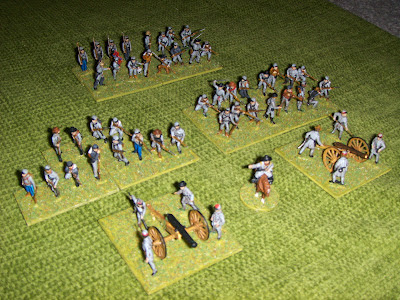
Progress on the ACW Plastic 1/72 figures! I have now reached roughly the one-third point in finished bases, and am currently battering on with painting up the next third. Here's some pictures, to show the finished articles.

The full total now stands at one General, 11 Infantry brigades, and 2 bases of Artillery. It's a nice little force of something like 23-24,000 men.
In other news, I hear via dealers on the internet that Italeri are re-releasing their range of Union infantry later this year, so that'll be perfect timing to let me save up for them when they appear, and then complete my force for a Gettysburg re-fight!
Sunday, March 25, 2012
Weekend's Results
I've had a quite productive weekend painting-wise, and thought I'd pass on the results:
 First up, the newly-sprayed ACW figures are now ready for painting, and a start has been made. I've done the first four bases if infantry (or, to think more encouragingly of it, around 8,000 men) full to completed painting and Devlan Mud coated on. I also tested out two shades of green for two of the bases, as I intend to grass them and wasn't sure what it was worth doing as a 'base' colour.


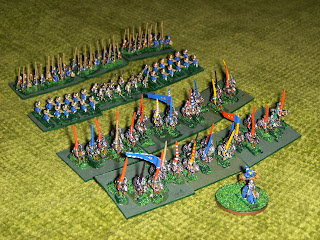


Also, I have completed one General figure, plus I have managed to paint all the gun carriages on the army's cannon. Tedious stuff to paint a cannon, what with all the gaps between the wheel spokes and so on - so it's nice to know it's gone for good!
In addition to this, I also managed to do a bit of re-basing!

Here is the old 6mm army of Baccus Wars of the Roses figures which I found idling in the loft, and have now rebased on 40mm x 20mm 'traditional' sized DBA bases, with much prising off of models and swearing. Above is an English 100-Years' War army while below is a Medieval French army. More to follow, hopefully - plus a bit of tabletop gaming!

Thursday, March 8, 2012
Plastic ACW Arrivals
The boxes have arrived! Well, they actually arrived about a week ago, but I was compelled to go on a short-notice business trip, so this is the first chance I've had to post anything on them.


It seems that there is no Confederate cavalry set easily available, but these should do (blue plastic notwithstanding for the moment.) They're all a bit smart and neat at present, but thankfully the Infantry box sets feature a mounted officer, so I should be able to convert a little bit on their bases.

Speaking of bases, here's the rather nice 2mm MDF bases which have also arrived. I've laid them out in the number needed for the NVA. Each division should be 3, 4 or 5 bases/brigades, while each corps gets 2 Artillery bases to represent its' collective artillery, and the army also gets a half-dozen bases of Cavalry for scouting and raiding.
Next step is the preparation for painting.
Wednesday, February 29, 2012
1/72 American Civil War

I'm still progressing with the Waterloo Campaign painting in 1/72 scale, but this is clearly going to be a long-term thing. Lots of slow & tedious painting just to get things out of the way, with precious little by way of a game. Something else is needed; something to cash in on the excellent price of the 1/72 plastics, and bring more short-term rewards than the long-term 'big daddy' project of them all!
I've taken the plunge and decided to buy some others for another period I've always struggled to find a good scale to game in - the American Civil War. I've played it in DBA-games of 2mm and 15mm, but the scale I wanted wasn't really there (it was in 2mm, but I had unwisely based the 2mm on too-small bases, which makes them painfully 'fiddly', and I didn't want to invest in more just yet.) I even got some Perry 28mm figures a long, long time ago. Problem is though, that if I want to do ACW on a big scale (and let's be honest, I probably do want to do things on a big scale) then a balance has to be struck between the biggest possible figure size and the economy of fielding a large number of them on a table.
As I've covered before, the cheap price of 1/72 figures (or, more accurately, my belated realisation of it) has been a real game-changer. As such, I've bitten the bullet and placed an order online for a bunch of 1/72 ACW figures. My plan is to build things up to roughly a 1-base-per-brigade level, but each base is being done strictly on 'DBA' lines so just 4 figures are required for a unit (as compared to 10 on the big 'Waterloo' system.) This should keep the whole project strictly 'small scale' in painting terms and 'big scale' in game terms. In fact, in terms of scale it's roughly on a level with Big Battle DBA (or BBDBA, where all base-numbers are trebled.)

So, the order: I've sent off to Gladstons (a shop I found with some online searching, previously called modelkit.co.uk) for 3 boxes each of Confederate Infantry (by Italeri, who seem to do some of the best figs from what I've seen so far) and three of Union Artillery (seems there's no Italeri Confederate Artillery, as they're interchangeable. Also, most ranges only ever seem to have 2 Cannon per box as opposed to the 3 or 4 you get in Napoleonic boxes - at least I've lots of caissons for camps, etc!) I've also rounded it off with a single box of Cavalry figures. My aim is to make up the Confederate Army of Northern Virginia (ANV) in full, with the Union's Army of the Potomac to follow at a later date.
Also, what of Generals? It seems that the plastic ranges generally do the rank & file quite well, but command is a rarity. I decided that I'd need some commanders, and so resolved to also get some lead figures to go with the plastic. Although 1/72 would imply 25mm scale for a typical 6-foot man, I gathered from reading advice forums online that this tended to be a bit over-generous and looked odd. 20mm seems to be the 'go to' figure scale to combine with the 1/72 plastics. Shame I don't have any 20mm collections! After a bit of looking about for a UK-based manufacturer, I settled on Newline Designs and decided to
give them a chance. They didn't have any specific 'Generals' in figure form, but they do 'Mounted Infantry command in a slouch hat' so I figure that's near enough to modify as needed.
Last, I need bases. I used to make them myself, until it dawned on me how cheap it was to buy them from suppliers. I went to Warbases to get some, and bagged a couple of sets made from 2mm MDF. The plan is to follow the recommended basing system from DBA, which for 20/25mm means a 60mm frontage and 30mm depth for infantry. I have also got a set of 60mm x 60mm bases for the artillery and cavalry (coincidentally also the size I'm using throughout in the Waterloo set, so it'll be interesting to get a look at them.)
The plan is to base the figures right away, and paint them when mounted. This has worked pretty well for me in the past on projects like the 10mm WW2 Desert Campaign figures I bought. Sadly it's not usually possible for things like my 15mm Seven Years' War armies or my Waterloo project, as they tend to be packed with figures and therefore impossible to paint after basing. This more restrained project has only 4 infantry figures to a base, and should therefore be viable. Delivery should take place within the next few days!
Sunday, January 8, 2012
The Anglo-Allied Army List
I have, at present, three different sources for Waterloo army lists. First is the original Horse Foot & Guns (DBA-style) rules by Phil Barker which give lists for all three armies; next is the Waterloo Companion book which is far more detailed and complete; and finally there is the Wikipedia page giving the lists for all troops in the campaign. In going through these three even in my own casual style, it's swiftly become clear that nobody quite agrees! Typical...
So, I have gone through it myself and adapted the HFG lists as I feel suitable, to fit with the Waterloo Companion lists which are far more detailed and therefore I suspect as being far more accurate. I imagine the original lists may have been compiled with a balanced 'points total' in mind, but I am not too big on points for wargaming.
Ignoring any historically accurate 'technical' nomenclature, and simply calling all bases 'Brigades':
The list for the Anglo-Allied Army:
The reserve was under Wellington's direct command, so he is listed as the corps command unit here as well as being the army commander. The divisional level has been skipped out here, and troops are generally grouped by nationality.
Brilliant CP - Wellington
Bay[short for Bayonets, i.e. Infantry] (British) - Kempt's Brigade
Bay (Highland) - Pack's Brigade
Bay (British) - Lambert's Brigade
Inferior Bay (Hanoverian Landwehr) - Vincke's Brigade
Inferior Bay (Hanoverian Landwehr) - Best's Brigade
Light Infantry (Brunswick) - Rauschenplatt's Brigade
Bay (Brunswickers) - Specht's Brigade
Bay (Nassauers) - Kruse's Brigade
British Smoothbore Foot Artillery - Drummond
Hanoverian Smoothbore Foot Artillery - Braun
British RHA Smoothbore Horse Artillery - Ross/Beane
Supply Base
Below is the list for the 1st corps - mostly pretty clear-cut, except that the Dutch brigades are in some cases so large they have to be split up. Large brigades with components of a different nationality have been split along these lines to give a chance for recognising the different countries and maintaining a bit of 'colour'.
CP - Orange
Superior Bay (British Guards) - Maitland's Brigade
Superior Bay (British Guards) - Byng's Brigade
Bay (British) - Halkett's Brigade
Bay (KGL) - Ompteda's Brigade
Bay (Hanoverian) - Kielmansegge's Brigade
Bay (Dutch) - Bijlandt's Brigade
Bay (Dutch) - Saxe-Weimar's Brigade (partial)
Bay (Dutch) - Detmers' Brigade
Bay (Dutch) - d'Aubreme's Brigade (partial)
Bay (Belgian) - d'Aubreme's Brigade (partial)
Bay (Nassauer) - Saxe-Weimar's Brigade (partial)
British Smoothbore Foot Artillery - Adye/Williamson
Dutch Smoothbore Foot Artillery - Opstal
Dutch Smoothbore Foot Artillery - Smissen
Next, 2nd Corps. There are some modifications here. The original list by Phil Barker gave two bases of KGL Bayonets while I could only identify one brigade, and seemed to skip Lyon's brigade out. The Waterloo companion listed Lyon as being a brigade of Hanoverian Landwehr, so I decided to switch the second KGL unit of Bayonets to Hanoverian Landwehr and use them to represent Lyon's Brigade. As done elsewhere, I listed the Landwehr as 'Inferior' quality.
Identifying the Light Infantry was also a bit awkward. I went in the end for Mitchell's brigade, which did at least contain a regiment listed as light infantry. The other one was pretty easy to
guess as Adam's Brigade as it contained the famous '95th Rifles' of the Sharpe novels. Adam also got represented by a second base of regular Brit Bayonets however, as it contained the 52nd Regiment - noted as the numerically strongest unit in the army, and therefore well worth
representing with another base.
CP - Hill
Superior Light Infantry (British Rifles) - Adam's Brigade (partial)
Superior Light Infsntry (British) - Mitchell's Brigade
Bay (KGL) - Du Platt's Brigade
Inferior Bay (Hanoverian Landwehr) - Lyon's Brigade
Inferior Bay (Hanoverian Landwehr) - Halkett's Brigade
Bay (British) - Johnstone's Brigade
Bay (British) - Adam's Brigade (partial)
Light Inf (Dutch) - Anthing's Brigade
Inferior Bay (Dutch Militia) - de Eerens' Brigade
Inferior Bay (Dutch Militia) - d'Hauw's Brigade
British Smoothbore Foot Artillery - Gold/Hawker
Dutch Smoothbore Foot Artillery - Wijnands
Dutch Smoothbore Foot Artillery - Riesz
The Cavalry Corps got listed by Phil Barker as having two fewer units of cavalry than I could find brigades listed. So, I simply added them in! Not sure exactly which ones got skipped, but the two British Light Cavalry bases I added got tentatively identified as Vivian's & Arendschildt's brigades.
CP - Uxbridge
Superior British Heavy Cav (Household) - Somerset
British Heavy Cav (Union Brigade) - Ponsonby
Inferior Dutch Heavy Cav (Carabiniers) - Trip
British Light Cav (Hussars) - Grant
KGL Light Cav (Hussars) - Dornberg
British Light Cav (Lt Dragoons) - Vandaleur
Hanoverian Light Cav (Hussars) - Estorff
Dutch Light Cav - Ghigny
Dutch Light Cav - Merlen
British Light Cav (Hussars) - Vivian
British Light Cav - Arentsschildt
British RHA Smoothbore Horse Artillery - Bull/Webber-Smith/Gardiner
British RHA Smoothbore Horse Artillery - Whinyates/Ramsay/Mercer
Dutch Smoothbore Horse Artillery - Petter/Pittius
So, no small amount of work there for 2012!
Sunday, December 4, 2011
The Anglo-Allied Army
Good news! The Anglo-Allied Army is indeed adequately represented! Here is another photo, identical to the one above, showing the figures dealt out to each base.

After lots of snipping figures off sprues, I now have enough for each base. Looking at them all in one go, some things stand out. Specifically, the variation in Quality! Revell are good but a touch thin and elongated; Airfix are strangely mis-shapen; Mars appear to not use plastic at all, but rather some strange substance closer to old chewing-gum than anything else; HaT are good and generally more 'uniform' in pose than anything else. The two stand-out facts are a) Italeri are easily the best quality, and b) there really is no excuse these days to not mould a horse and its base as a single unit (you hear that Airfix, Mars and Esci? We all hate trying to fix some horse's leg into a tiny slot!)
Next up, the job of slowly glueing each set of figures to a strip of cardboard!
Saturday, December 3, 2011
Anglo-Allied Stock-taking
I thought I'd just write this up as I go, as I'll probably not get round to it at a later date. Here is, with photos, my attempt to sort out the entire Anglo-Allied Waterloo Campaign army with my plastic purchases!

The 'plastic mountain' in it's full horror/glory. The Anglo-Allied army, because of the variety of unit types it seems to have contained, required the most box-buying of plastics. Now I should be in a good situation to completely, or very nearly, model the whole thing!

Manufacturers are a mad combination of whatever I was able to get my hands on. As a rough rule of thumb, the ones for Italieri & Revell seem to be generally best quality, while Airfix are the most variable. Luck of the draw, really! However, there are sites available which you really can't do without.
On a similar note, what do they all look like? Well, there's another site which I have turned to and it has supplied me with ludicrous levels of information. Generally, for each base/brigade, I have looked up the largest or most notable unit contained within it, and used its uniform as representative. Now, to the plan:

These square bits of card are the 6cm x 6cm bases I intend to use. The four broad columns are, left to right, Orange's I Corps, then Hill's II Corps, Uxbridge's Cavalry Corps and Wellington's Reserve Corps. Roughly each base is a brigade, and it's broadly as per the Horse Foot & Guns army-list, but I have tinkered slightly based on reading through my book 'The Waterloo Companion'. You'll see that some bases have had some figures placed on them - these are the ones which I have taken off their sprues, & base-coat sprayed with plastikote as a test-attempt. Now I'm ready to go Industrial-Scale, and do as many of the rest as I can!
One point of interest, however, on plastic figures: I usually mount figures onto wooden ice-lolly sticks, but the smooth base of the plastics is not as rough as lead-cast figures' bases usually are. Figures I tried here to glue to wooden sticks simply snapped off with barely a touch, but strips of cardboard (from a cut-up cereal box) seem to be much more effective! Plus, you can be much more liberal with the glue - if you're fighting to get them off later, card can be cut away simply enough while a little wooden stick would probably be more resistant than your soft-plastic figures were!
More updates as I progress...
Subscribe to:
Posts (Atom)